שיתוף | הבא ליטהר מסייעין אותו
-
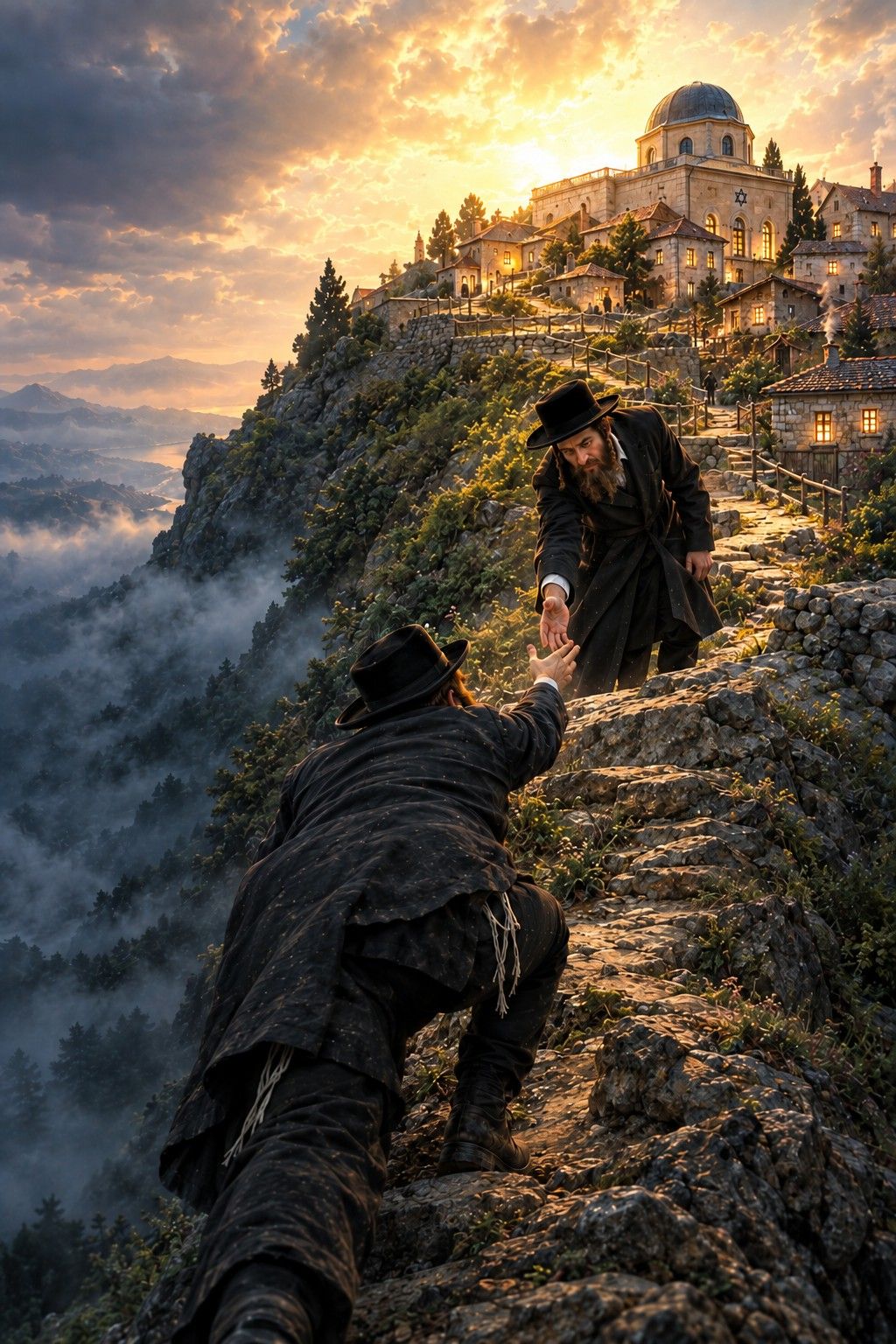
הכלי / המודל: GPT-5.6 Luna
הפרומפט:Create a breathtaking cinematic, highly detailed storybook illustration inspired by the Jewish idea “הבא להיטהר מסייעין אותו”. IMPORTANT COMPOSITION: The viewer is positioned directly behind and slightly above the climber's own line of movement, experiencing the ascent from the climber's perspective. The entire composition must unmistakably move UPWARD. The visual direction must never suggest descending. Show a SINGLE, CLEAR, STEEP MOUNTAIN TRAIL that begins in the dark lower part of the mountain and continuously winds upward toward the summit. The trail must be wide enough to clearly recognize as a real mountain path, with visible packed earth, exposed rocks, uneven natural stone steps, bends and footholds. It must be obvious where the climber has come from and exactly where he is going. The trail zigzags naturally upward across the mountainside and becomes progressively more illuminated with every turn. The viewpoint should feel physically present ON the trail, looking UP the mountain. Never show the trail going downhill toward the viewer. Never create a cliff face with no route. The mountain must have a believable climbing route. A single Jewish man is actively climbing upward on this trail. His posture must unmistakably communicate ASCENT: torso leaning forward and upward, one foot planted higher on the next rock, the other foot pushing upward from below, one hand reaching toward a natural handhold above him. His entire body is oriented toward the summit. He must look like a real exhausted person struggling to climb a steep mountain, not someone walking downhill. The climber should occupy the darker lower-middle and foreground portion of the image. He must be partly surrounded by cool atmospheric shadows and darker mist. Strong soft shadows should gather around the edges of his legs, boots and lower body, making him visually emerge from darkness. His clothing should remain predominantly dark and subdued, with only subtle reflected warm light from above touching his shoulders and reaching hand. Use a dynamic low-to-high perspective following the direction of the climb. The mountain rises overwhelmingly above the viewer, while the path creates a powerful visual line toward the summit. At the very top of the mountain, far above the climber, place a BEAUTIFUL, COHERENT HISTORICAL GALICIAN JEWISH SHTETL. It must clearly read as ONE small traditional Jewish town rather than scattered or confused buildings. Create a compact cluster of old stone and plaster houses with pitched roofs, narrow streets, tiny courtyards, chimneys and warm glowing windows. The settlement should follow the natural terrain and form a believable little town perched near the summit. The summit and shtetl are surrounded by magnificent warm golden light, while the lower mountain remains dark, cold and covered with mist. The entire visual journey is from darkness below toward light above. IMPORTANT HELPER POSITION: Near the UPPER SECTION of the trail, very close to the Jewish town and just below the settlement, a traditional Galician Jewish man stands securely ABOVE the climber on a stable rocky section of the path. He must be physically close to the town, clearly much higher than the climber, and positioned where the warm light from the settlement begins. He leans DOWN toward the climber and extends one hand toward him. His body position must make it completely unmistakable that he is ABOVE the climber and helping him ascend, not descending himself. He has the appearance of a traditional 19th-century Galician Jewish man: full beard, subtle sidelocks, dark long coat, traditional clothing and an old-fashioned black hat. His expression is compassionate, encouraging and focused on helping the climber. The climber reaches UP toward the helper's hand. Their hands are almost touching. This is the central emotional moment: the climber has struggled upward through darkness, and someone standing above him reaches down to help him continue the ascent. Include several naturally occurring stone steps, footholds and small sections of reinforced mountain path along the route, visually suggesting that help appears precisely where the climb becomes difficult. These must be integrated realistically into the mountain. SYNAGOGUE DESIGN — EXTREMELY IMPORTANT: The central synagogue in the hilltop Jewish town must be unmistakably a JEWISH synagogue and must NOT resemble a Christian church. The synagogue should be inspired by historic Safed/Tzfat Jewish architecture, with a large rounded Jewish-style dome rising from a substantial rectangular stone synagogue building. The dome must have NO CROSS, NO CROSS-SHAPED FINIAL, NO CHURCH SPIRE and NO CHRISTIAN SYMBOL whatsoever. The top of the dome should have only a small simple Jewish architectural finial or subtle neutral cap. On the FLAT ROOFTOP / TERRACE of the synagogue, directly in front of and below the dome, place a large beautiful traditional SEVEN-BRANCHED JEWISH MENORAH. The menorah must clearly stand on the flat roof terrace, NOT beside the building, NOT floating, and NOT on top of the dome. The menorah should be clearly visible in silhouette against the golden sky and positioned BEFORE the dome from the viewer's perspective. The synagogue may include subtle Jewish architectural details such as arched windows and a Star of David, but absolutely no Christian symbols. NO CROSS ABOVE THE DOME. NO CROSS ON THE BUILDING. NO CHURCH ARCHITECTURE. NO CHRISTIAN SPIRE. NO CHRISTIAN FINIAL. The menorah must have exactly seven branches and must be recognizable as a traditional Jewish menorah. The shtetl should feel historically Jewish, warm, coherent and believable, not like a fantasy castle. LIGHTING: Create a powerful transition from darkness to light. The lower trail and climber are immersed in cool blue-gray shadows, mist and atmospheric darkness. The climber's legs and boots should have darker shadow pockets around them, emphasizing that he is still emerging from darkness. The helper above receives warmer light. The town and synagogue are bathed in magnificent golden illumination. The golden light should visually pull the eye upward from the climber's outstretched hand toward the helper, then toward the synagogue and luminous Jewish town. The image should communicate one unmistakable visual sentence: “A man struggling UPWARD from darkness, following a steep mountain path toward a luminous Jewish town, while another Jewish man ABOVE him reaches DOWN to help him climb higher.” Style: Cinematic historical storybook painting, highly detailed traditional illustration, painterly realism, realistic anatomy, expressive poses, dramatic mountain scale, powerful upward perspective, atmospheric depth, mist, volumetric golden light, richly textured rocks, detailed 19th-century Jewish architecture, warm glowing windows, believable Galician shtetl, majestic composition, emotionally powerful but believable. ABSOLUTELY NO: downhill composition, descending path, staircase leading downward, cliff with no trail, floating buildings, chaotic collection of houses, modern architecture, fantasy castle, multiple climbers, duplicated people, Christian church, cross, crucifix, cross-shaped finial, church spire, Christian symbols, menorah on top of dome, menorah floating in the air, menorah behind the dome, text, captions, letters, logos.

שלום! נראה שהשיחה הזו מעניינת אותך, אבל עדיין אין לך חשבון.
נמאס לכם לגלול בין אותם הפוסטים בכל ביקור? כשנרשמים לחשבון, תמיד תחזרו בדיוק למקום שבו הייתם קודם, ותוכלו לבחור לקבל התראות על תגובות חדשות (בין אם במייל, ובין אם בהתראת פוש). תוכלו גם לשמור סימניות ולפרגן ב-upvote לפוסטים כדי להביע הערכה לחברי קהילה אחרים.
בעזרת התרומה שלך, הפוסט הזה יכול להיות אפילו טוב יותר 💗
הרשמה התחברות